
Automatic failover with ruvio coordinator
ruvio coordinator is a separate process, started from the same binary, that watches replication
groups (a primary and its replicas) and fails a group over when its primary stops answering. It holds
no data and serves no data commands. Run three (or five) of them; they agree through Raft on which
member of each group is the primary, and only a majority can change it.
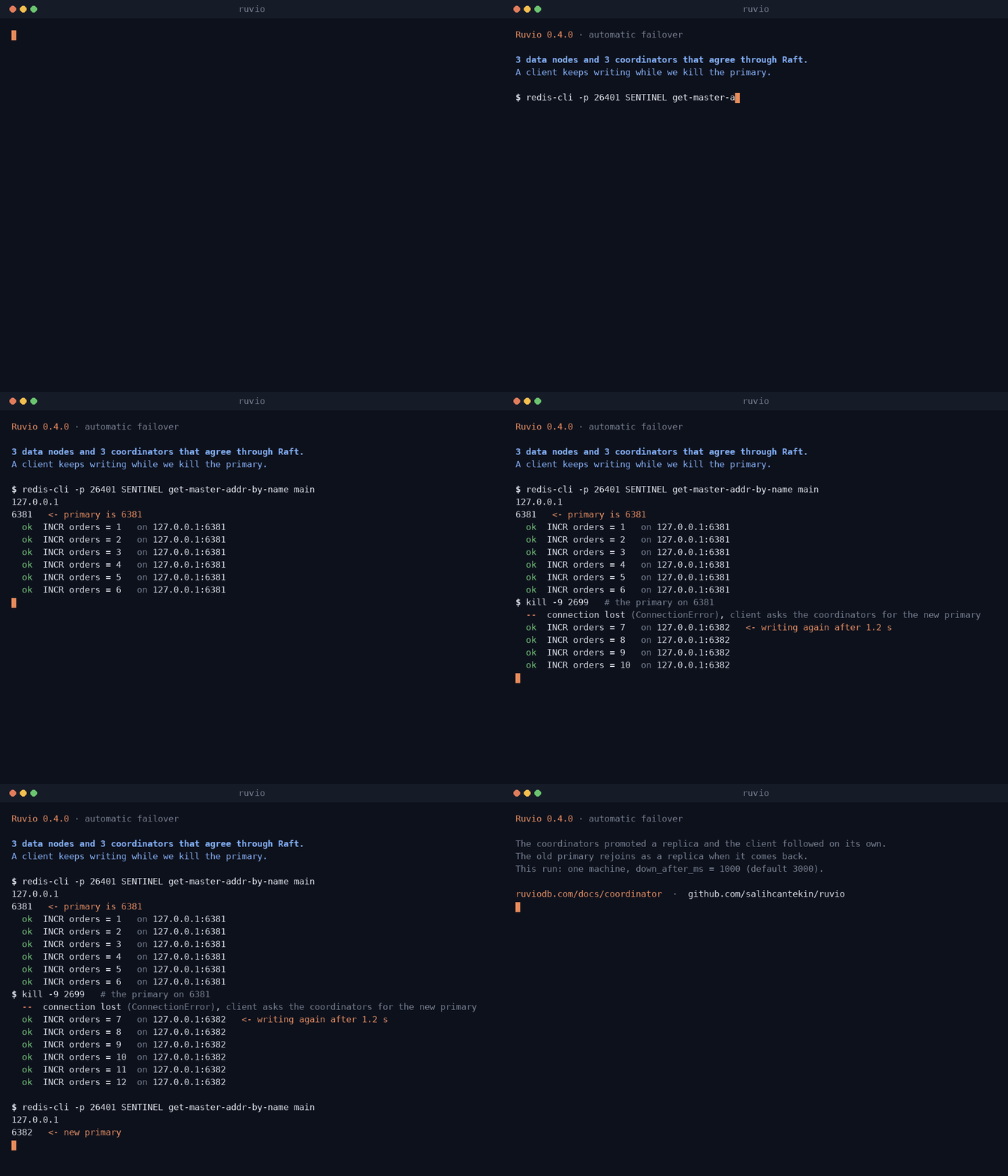
The recording above runs three data nodes and three coordinators on one machine with ping_interval_ms 200 and
down_after_ms 1000 (the defaults are 500 and 3000); the Python client finds the new primary through the
coordinators with sentinel_master.
Without coordinators nothing changes: a primary and its replicas run as described in
Recovery, Backup, and Integrity, and promotion is a person running REPLICAOF NO ONE.
What happens on a failure
Section titled “What happens on a failure”- Every coordinator connects to every member each
ping_interval_msand readsROLE,CONFIG GET shards,INFO server(run_id) and, from every shard on its own port,ROLEandINFO replication(the synced and the committed sequence of every shard). A member is heard from only when all its shards answer: a primary with one shard down is failed over like a dead one, and a replica with a shard down is not promoted. With the primary lease, a coordinator does not renew the lease of a primary with a shard it cannot reach. A member that answers on some shards keeps the role it had and is pointed at the agreed primary once all its shards answer again. - When the Raft leader among the coordinators has not heard from the primary for
down_after_ms, it asks the others. The primary is down when a majority of coordinators (the leader included) have not heard from it withindown_after_ms. One coordinator’s own network trouble cannot start a failover. A coordinator that just started counts a member it has not heard from yet as silent only since its start, so restarting the coordinators does not fail over a primary that answers. - The leader picks the replica that answers, is not still copying its primary (
LOADING), and holds the most of the history (the largest sum ofwal_durable_sequenceover its shards); ties go to the member listed first. WithCLIENT DURABILITYin use it must also hold every committed write (see below). Right before recording the promotion it looks at that replica once more; one that no longer answers (it died with the primary) is not promoted, and the next round chooses again. - It records “primary = that member, epoch + 1” in the Raft log (a majority must accept it), sends the
member
REPLICAOF NO ONE, points the other members at it withREPLICAOF host port YIELD, and publishes+switch-masterto subscribers. - A member that answers again and disagrees with the record is corrected: an old primary is made a
replica of the new one. It continues from its own log when it wrote nothing after the new primary
forked, and takes a full copy otherwise (see Write history in Recovery, Backup, and Integrity).
YIELDkeeps a member that forked a newer epoch of its own (a replica restarted with a primary’s configuration) from fencing the recorded primary; a member of an older build that does not knowYIELDgets plainREPLICAOF.
If the leader coordinator dies, the remaining ones elect a new leader (one to two seconds) and carry on. Commands to data nodes are repeated on every tick until the members agree with the record, so a failover interrupted half way is finished by the next leader.
When the coordinators are partitioned from each other, only the side with a majority acts. The Raft
library keeps a leader that lost its majority believing it leads, so before each tick’s work on the data
nodes (a failover, pointing members at the agreed primary, sending the cluster map, a step of a slot
move) and before COORDINATOR FAILOVER group FORCE, MOVE, CANCEL, ADD and REMOVE, the leader confirms with a
heartbeat that a majority of coordinators still follows it. It confirms again before every command it
sends a data node; a confirmation is trusted for one ping_interval_ms (capped at 1 second, below the
election timeout) and shared by everything in that window, and waits at most that long. So a leader that
loses its majority in the middle of a tick sends no further REPLICAOF or map from a record a newer
leader may have replaced. Each group is tended on its own task, and a data node gets down_after_ms
(at least 1 second) to answer a command: a member that accepts connections but stops answering holds up
only its own group, never a failover elsewhere. A leader cut off from the others, even one that still reaches every data node, therefore does
nothing to them: it logs one warning, those commands answer ERR this leader cannot reach a majority of coordinators; try again, and it acts again (logging that once) when the majority answers it, or follows
the leader the majority elected meanwhile. The other side, if it is a majority, elects a new leader and
fails over as usual.
Measured on one Mac with three data nodes and three coordinators (ping_interval_ms 200,
down_after_ms 1000, debug build): the new primary took writes 1.2 seconds after the old one was killed;
with the coordinator leader killed first, 3.2–4 seconds.
What can be lost, and split brain
Section titled “What can be lost, and split brain”Replication is asynchronous. Writes the old primary acknowledged but had not yet shipped are not on the
new primary. In a test that wrote continuously while the primary was killed, 0–1 of about 225
acknowledged writes were missing afterwards, always the last ones. A client that cannot lose a write
turns on CLIENT DURABILITY REPLICAS 1 for its connection: every reply then waits until a replica
holds the writes before it on disk, and becomes NOREPLICAS if none does within the timeout (default
5000 ms; the writes stay applied). Until a replica holds those writes, every later reply on that
connection, reads included, waits out its timeout and becomes NOREPLICAS too, so the connection never
shows a write that a failover could take back; once a replica catches up, replies flow again at once. A
service that must keep reading while its replicas are down reads on a connection without durability. The client libraries
have a connect option that sends it on every connection. WAIT 1 timeout_ms after a write does the same for one write at a time.
A failover keeps such writes as long as the coordinators learned that they were committed (see
What can still lose data below for the shapes where they cannot). The primary records, per shard, the highest sequence it released a
durable reply for (replication_committed_sequence in INFO) and passes it to its replicas; every
coordinator reads it from the members’ INFO replication on each ping and keeps the highest value it
has seen per group and shard. The leader promotes only a replica whose wal_durable_sequence is at
least that value in every shard, and among those the one holding the most. When no answering replica
qualifies, it does not fail over: it logs a warning on every tick and waits, and the group has no
writer meanwhile. Two ways out, both losing the records the promoted replica lacks (the leader logs
which, per shard):
unclean_failover = trueincoordinator.tomlpromotes the best replica anyway, every time.COORDINATOR FAILOVER group FORCEon the leader (afterAUTH secret) does it once, now, and answers the promoted member’s address. It is refused while the primary still answers the leader, and by other coordinators withERR not the leader; send it to coordinator <id>.
After a failover to a replica that held every committed record, the values still apply, so the next
failover also waits for a replica that caught up. After an unclean one those records are gone and the
new primary reuses their sequence numbers: the old values are dropped, and the stale ones replicas keep
reporting are ignored until the new primary commits past them. Which of the two applies is decided
once, by the leader that promotes, and recorded in Raft with the promotion. The leader also writes
the values through Raft when they rise: at most once a second, one entry for all groups, only the
shards that rose. Every coordinator starts from that record, and a new leader acts only once it has
applied the log of its own term, so a new leader, or coordinators that all restarted while the
primary and the replica holding the records are down, still wait for a replica that has them. A value
that rose in the last second before the leader died may not be recorded yet; the other coordinators
also learn the values from the members on every ping. A recorded value that can never be reached
again (for example a primary restarted at the same epoch with durability memory, whose sequences
start over) stays until a failover with FORCE or unclean_failover, also across coordinator
restarts. Coordinators’ INFO shows the recorded values as recorded= and the known ones as
committed= on the group’s line. Groups whose clients never use CLIENT DURABILITY report 0
everywhere, write nothing, and fail over as before.
The coordinators learn committed values only from the members they reach: the primary, and the replicas
following it (the primary passes the value on to them). A write acknowledged with CLIENT DURABILITY REPLICAS k is on at least k replicas, but when those replicas are cut off from the coordinators
together with the primary, the coordinators never see that value, count the replica they can reach as
complete, and promote it. With REPLICAS equal to the number of replicas in the group every replica
holds every acknowledged write, so whichever one is promoted has it; with fewer, an acknowledged write
can be lost in that shape (see the table below).
IDEM, ONCE, LIMIT and LEASE are ordinary writes in this respect: they survive a failover exactly
when an acknowledged durable write does, and the last ones can be lost without CLIENT DURABILITY.
Their deadlines are wall-clock times, so the nodes’ clocks must agree. See “Across a failover” in
Native idempotency (IDEM) for the details and a lock recipe.
An old primary that keeps taking writes
Section titled “An old primary that keeps taking writes”A primary that does not learn it was replaced keeps taking writes, and they are lost when it rejoins as a replica. It learns in three ways:
- A coordinator reaches it again and makes it a replica of the new primary (within a ping).
- The epoch: a replica that follows the new primary refuses the old one, and the old one stops taking writes as soon as such a replica connects to it.
min-replicas-to-writewithmin-replicas-max-lag(seconds): the old primary refuses writes withNOREPLICASonce fewer replicas than the first value acknowledged within the second. It checks every 100 ms, so it refuses at mostmin-replicas-max-lag+ 0.1 seconds after the last replica it needed stopped acknowledging.
How long the window lasts depends on which replicas the old primary still reaches:
- Cut off from the coordinators only. Its replicas still reach the coordinators and are pointed at
the new primary, so they stop acknowledging the old one. With
min-replicas-to-write 1it then refuses writes within the lag; in the partition test it refused 0.1 seconds after the failover. With the defaultmin-replicas-to-write 0it keeps taking writes until a coordinator reaches it again. - Cut off together with one of its replicas, while another replica stays with the coordinators.
That replica is promoted, and the one that stayed with the old primary keeps acknowledging it, so
min-replicas-to-write 1stays satisfied and the old primary takes writes for the whole partition. Onlymin-replicas-to-writeequal to the number of replicas (every replica) bounds it: the old primary then refuses writes at mostmin-replicas-max-lag+ 0.1 seconds after the cut. The promotion comesdown_after_msafter the coordinators’ last answered ping of the primary, which is normally less than oneping_interval_msbefore the cut (longer when a ping to another member is slow). With the defaults (min-replicas-max-lag10,down_after_ms3000,ping_interval_ms500) both primaries take writes for up to about 7.5 seconds. Keep the lag well belowdown_after_ms, for examplemin-replicas-max-lag 2withdown_after_ms 4000, so the old primary stops first. The price: losing any one replica stops writes in the group.
Writes the old primary took in the window are lost in both shapes. Use min-replicas-to-write 1 (or
higher) in every group a coordinator manages, and the number of replicas or the primary lease where a
split must stay bounded.
Primary lease
Section titled “Primary lease”With primary_lease_ms set on the coordinators and primary-lease yes on the data nodes, an old
primary stops taking writes before a replica is promoted, whatever replicas it still reaches. Both
are off by default.
- Every
ping_interval_ms, each coordinator renews the lease of the member its own record names as the primary, each group on its own task and connection, so a slow or silent member elsewhere never delays it:RUVIO LEASE BEGIN(the node notes the instant on its own clock and answers a token), thenRUVIO LEASE GRANT token coordinator voters epoch lease_ms. The lease runslease_msfrom the BEGIN instant, so a grant that arrives late only shortens it. A grant for an older epoch than a running grant the node holds is refused, a newer epoch drops the older grants, and a node that is a replica refuses grants. A grant that ended is forgotten and refuses nothing, so coordinators that start over at a lower epoch (a lostdata_dir, or the Raft files deleted to go back a release) are taken at most one lease later. The majority is counted against the largest number of coordinators (voters, at most 255) that a running grant of the current epoch names, each coordinator’s latest grant setting its count; a new epoch starts the count again. - A writer (a primary, or a node with no replication role) takes writes only while grants from a
majority of the coordinators run for more than 300 ms more. It checks this on the same 100 ms
tick as
min-replicas-to-write, so nothing is added to the commands themselves; otherwise writes getNOREPLICAS Primary lease expired: too few coordinators renewed it.(the code clients already handle asNOREPLICAS). A primary starts refusing, and so does a promoted replica, until the first grants arrive (one ping after its promotion). The 300 ms cover the writes taken between two checks and a stall of the node of up to about 200 ms. - When the leader no longer hears from a primary, it asks every coordinator two questions: does
it hear the primary, and has its last grant to it aged past the lease stretched for clock drift,
times (100 + d) / (100 - d) with d the
primary_lease_drift_percent(default 10), plus 200 ms (2645 ms for a 2000 ms lease), by that coordinator’s own settings. A coordinator that answers “ended” promises not to grant that member again until the leader confirms that its record still names it; the leader answers only after any failover it is deciding is recorded, and only once a majority of coordinators confirmed it still leads. A failover goes ahead when a majority no longer hears the primary and a majority reports its lease ended. So a coordinator that reported the lease ended renews it only for a primary the record still names after that, and any majority that granted the old primary shares a coordinator with the majority that reported it ended.COORDINATOR FAILOVER group FORCEwaits for this too: it is refused while a majority still hears the primary and grants leases, or while its lease runs. - A coordinator that just started reports every lease as granted at its start, and grants nothing until the leader confirmed the primary.
primary_lease_msmust be at least three timesping_interval_ms, at leastping_interval_msplus 500, and at most 60000, and the stretched lease plus 200 ms must fit indown_after_ms, so detection is not delayed: with the defaults (ping_interval_ms500,down_after_ms3000),primary_lease_ms = 2000.primary_lease_drift_percentmust be below 100, and at most 255 coordinators can grant a lease.- Each coordinator waits at most 1 s for a node’s answer while renewing. A primary that answers later
(a slow disk, a long pause) misses that coordinator’s grant for the round, and once its running
grants fall below a majority with 300 ms left it refuses writes with
NOREPLICAS Primary lease expireduntil the next grants arrive; with the defaults a stall of about 1.7 s is enough. On nodes that stall like this chooseprimary_lease_ms3000 to 4000 and raisedown_after_msto fit the rule above.
What it assumes and what it does not cover:
- Every coordinator’s and data node’s clock runs at most
primary_lease_drift_percentfaster or slower than real time. The stretch covers the worst pair: a node clock that runs slow by d holds the lease for up tolease / (1 - d)of real time, which a coordinator clock that runs fast by d measures aslease * (1 + d) / (1 - d). The clocks need not agree on the time. On Linux a data node measures the lease withCLOCK_BOOTTIMEand the coordinators with the monotonic clock, so a data node host that is suspended (laptop sleep, VM suspend) counts the suspended time and wakes with its lease expired; on other platforms the node’s clock may stop while suspended. - Writes the old primary takes between the cut and the end of its lease (at most
primary_lease_ms- 0.1 s) are still lost when it rejoins. The lease bounds the window; only
CLIENT DURABILITY REPLICASequal to the number of replicas keeps acknowledged writes in every shape below.
- 0.1 s) are still lost when it rejoins. The lease bounds the window; only
- A primary whose process stalls (paused VM, swapping, a long
SIGSTOP) for longer than the 300 ms margin, with the stall starting just after a check that found the lease running, may apply writes on resuming before its next check closes the gate. Each shard checks on its 100 ms maintenance tick, which is due at once after such a stall, but the connections’ tasks may run first: the writes already waiting on its connections, and those that arrive before the check runs, can be applied. This is normally one round of reads, but it has no fixed bound in time or count. - When a majority of the coordinators are down or cannot reach the primary, every primary stops taking writes after its lease: a coordinator outage becomes a write outage.
- A data node takes
RUVIO LEASE GRANTonly from the coordinator ids in itsprimary_lease_coordinatorsand only with a coordinator count equal to that list’s length, so a client withruvio|leaserights cannot invent a majority; it can still sendRUVIO LEASE BEGIN: the node keeps the last 64 BEGIN tokens of all connections together, so a flood of them makes the coordinators’ grants arrive with unknown tokens and lets the lease run out. Give it only to the coordinators’ user.
Turning it on:
- Upgrade the data nodes (they accept
RUVIO LEASEand ignore grants whileprimary-leaseis off). Setprimary_lease_coordinatorson every data node to the ids of your coordinators ([1, 2, 3], orRUVIO_PRIMARY_LEASE_COORDINATORS=1,2,3) and restart it: grants from other ids, or from a coordinator that counts a different number of coordinators, are refused. The coordinators’ data-node user needsRUVIO(ruvio|lease). - Upgrade all coordinators together (see Upgrading), then set
primary_lease_mson each and restart them one at a time. Mixed versions do not work with the lease: a coordinator of an older version neither grants nor answers the new lease query, so a failover waits for a majority that does (it never promotes on a missing answer) and its missing grants count against the majority; and an older leader cannot decode the confirmation a newer coordinator asks before it grants, so that coordinator grants nothing. Coordinators with the lease off still ask the others and wait for a lease any of them grants. - Last, the data nodes enforce it. Check
INFO replicationon the primary:primary_lease_grantsshould equal the number of coordinators andprimary_lease_remaining_msstay well above 300. ThenCONFIG SET primary-lease yeson every data node (andprimary_lease = truein their files, orRUVIO_PRIMARY_LEASE=yes).
Done the other way round, the primaries refuse writes until the coordinators grant them.
Turning it off: first CONFIG SET primary-lease no on every data node (and in their files), then set
primary_lease_ms = 0 on the coordinators, one at a time. In the other order the primary stops
writing once a majority stopped granting.
Changing primary_lease_ms or primary_lease_drift_percent: each coordinator reports a lease as
ended by its own settings. To lengthen the lease (or raise the drift), change it on every
coordinator; to shorten it (or lower the drift), restart the coordinators one at a time and wait the
old lease length after each restart, so no coordinator reports a lease ended by the new, shorter
length while a grant of the old length runs.
Changing the coordinators (COORDINATOR ADD/REMOVE, see Adding and removing coordinators):
a data node takes a grant only from the ids in its primary_lease_coordinators and only when the
grant’s coordinator count equals that list’s length, and the list changes only with a restart. So
while the lease is on, COORDINATOR ADD and COORDINATOR REMOVE are refused: a changed set would
stop writes on every primary until each node restarted with the new list. To change the set, turn
primary-lease off on the data nodes (CONFIG SET primary-lease no), add or remove the coordinator,
put the new list in every node’s primary_lease_coordinators, restart the nodes one at a time
(replicas first, then the primary, which fails over), and turn the lease on again.
Checked with Docker (debug build, ping_interval_ms 500, down_after_ms 3000, primary_lease_ms
2000, min-replicas-to-write 1 on every node), the old primary and one replica on one network, the
other replica and the coordinators on another, a client writing to the old primary throughout. Without
the lease the old primary took writes for the whole partition and about 475 acknowledged writes were
lost when it rejoined. With it, the old primary refused writes about 1.2 to 1.3 seconds after the
second coordinator lost it, the replica was promoted 1.3 to 1.8 seconds after that, and the writes
taken before the refusal (70 to 80) were lost.
What can still lose data
Section titled “What can still lose data”k is the CLIENT DURABILITY REPLICAS value of the writing connection, r the number of replicas in
the group, L the primary_lease_ms.
| Failure | Without the lease | With the primary lease | Writes with CLIENT DURABILITY REPLICAS k |
What the operator can do |
|---|---|---|---|---|
| Primary process or machine dies | The last writes it had not shipped are lost (0–1 of about 225 in the test above) | Same; the failover also waits until the lease counts as ended, which fits in down_after_ms |
None lost while a replica holding them answers: the coordinators learn the committed value from the primary or from the replicas, and promote only a replica holding it; otherwise the group waits | Use k ≥ 1 where a lost write matters; leave unclean_failover off |
| Primary cut off from the coordinators only, its replicas still reach the coordinators | Writes the old primary takes until it learns it was replaced are lost: within min-replicas-max-lag + 0.1 s with min-replicas-to-write ≥ 1, until the partition heals with 0 |
It stops at most L + 0.1 s after its last grant, before the promotion; the writes it took until then are lost |
None lost with k = r. With smaller k, a write acknowledged between the promotion and the moment the replicas are pointed at the new primary can be lost (with the lease the old primary has stopped by then) |
min-replicas-to-write 1 or more, or the lease; k = r for writes that must not be lost |
| Primary and one replica cut off together from the other replicas and the coordinators | The old primary takes writes for the whole partition unless min-replicas-to-write = r; with r it stops within min-replicas-max-lag + 0.1 s. Everything it took is lost |
It stops at most L + 0.1 s after its last grant, before the promotion; the writes it took until then are lost |
With k < r acknowledged writes can be lost (with the lease, only those taken before it stopped): the replica that stayed acknowledges them, the coordinators never learn the committed value, and the promoted replica lacks them. With k = r none: the old primary cannot get a reply released without the cut-off replica |
The lease; or min-replicas-to-write = r with min-replicas-max-lag well below down_after_ms (for example 2 with down_after_ms 4000); k = r |
| A majority of coordinators down, or cut off from the primary | Nothing is lost by it; data nodes keep serving, but a primary that fails meanwhile is not replaced | Every primary they cannot renew stops taking writes after L; nothing is lost |
Same as without the lease | Run three or five coordinators on different machines; without the lease, promote by hand with REPLICAOF NO ONE while none runs; with it, CONFIG SET primary-lease no on the primary to write without coordinators |
The primary’s process or VM paused longer than down_after_ms |
A replica is promoted; when the old primary resumes it may take writes until it learns it was replaced (as in the rows above), and they are lost | The promotion waits for the lease; on resuming, the old primary may apply writes already waiting before its next check, and those writes are lost; a stall shorter than 300 ms loses nothing | None lost with k = r: the replicas follow the new primary and do not acknowledge the old one |
min-replicas-to-write ≥ 1, or the lease |
| Clocks running at different rates | Timeouts are measured with each process’s own monotonic clock, so a rate difference only shifts when a failover starts | The lease is safe while every clock runs within primary_lease_drift_percent of real time; beyond it both primaries can take writes for a moment |
Same as without the lease | Keep clocks synchronized (NTP), also for the wall-clock deadlines of IDEM, ONCE, LIMIT, LEASE and SEMAPHORE |
| Coordinators of different versions | A newer leader falls back to the older query for coordinators that do not answer the lease query, so failovers work as before | Older coordinators neither grant nor report grants: failovers wait for a majority of the new version, and writes stop if fewer than a majority grant | Same as without the lease | Upgrade every coordinator before turning the lease on |
A CHANGES SUBSCRIBE consumer may already have seen records a failover takes back. Its cursor
carries the generation (the replication epoch) of the log it read, so when it resumes on the new
primary with a cursor past the fork, the stream first sends ["rewound", cursor] with the fork in
the new generation: undo or reload what was applied after it. A consumer that subscribes with
COMMITTED gets only records a CLIENT DURABILITY reply committed, which a coordinator’s failover
keeps (unless it was forced, unclean_failover is set, or the commit happened where the coordinators
could not see it, as in the table above), so it does not see one taken back; it sees nothing until durable writes commit. See
Configuration, Change stream.
A lost LEASE or SEMAPHORE grant does not come back as the same token: tokens carry the cluster
map’s version, which grows with every failover and every committed move, so the new primary’s tokens
are larger than any the old one handed out. A resource that keeps the largest token it has seen
refuses a holder whose grant was lost. Without a coordinator the generation is the replication epoch;
with a hand-written map and no coordinator, it is the larger of the epoch and the map’s version.
Setting it up
Section titled “Setting it up”Each data node needs replication.listen (so a promoted replica can serve replicas) and a WAL-backed
durability profile. Start the primary with replication.role = "primary" and the replicas with
replica; the coordinators take over from there.
coordinator.toml (one per coordinator; only id, listen and data_dir differ):
id = 1                                  # unique, listed in peerslisten = "0.0.0.0:26400"                # coordinators, Raft and the Sentinel API share this portdata_dir = "/var/lib/ruvio-coordinator" # Raft log, vote and snapshotpeers = ["1@ruvio-1:26400", "2@ruvio-2:26400", "3@ruvio-3:26400"]secret = "change-me"                    # shared by every coordinator; RUVIO_COORDINATOR_SECRET overrides itping_interval_ms = 500                  # default 500down_after_ms = 3000                    # default 3000unclean_failover = false                # default false: wait for a replica with every committed writeprimary_lease_ms = 0                    # default 0 (off); 2000 with the defaults above, see "Primary lease"primary_lease_drift_percent = 10        # default 10: how much faster or slower than real time a clock may run; below 100auth = "password"                       # how coordinators log in to data nodes; "user password" works toojoin = false                            # true only when adding a coordinator to running onestls_cert = ""                           # default empty: the coordinator port in clear text; see "Security"tls_key = ""tls_ca = ""                             # CA of the other coordinators' and the data nodes' certificatesnode_tls = false                        # default false: dial the data nodes with TLS
[[groups]]name = "main"members = [ { address = "ruvio-1:6379", replication = "ruvio-1:26379" }, { address = "ruvio-2:6379", replication = "ruvio-2:26379" }, { address = "ruvio-3:6379", replication = "ruvio-3:26379" },]ruvio coordinator --config coordinator.tomlThe coordinator is part of the ruvio binary in every release (Linux, macOS, Windows) and in the Docker
image; there is nothing extra to download. For a binary install,
deploy/coordinator.toml is a starting config and
deploy/ruvio-coordinator.service a systemd unit next to
ruvio.service: on each of three machines run one data node and one coordinator.
addressis the member’s RESP address (shard 0’s port), the one clients use.replicationis itsreplication.listenbase address, the oneREPLICAOFnames. Host names are resolved on every connection, so container names work.- On the first start the coordinators record as primary the member that answers
ROLEasmaster; while none or several do, they wait and change nothing. - The data-node user in
authneedsROLE,INFO,CONFIG(GET) andREPLICAOF, andRUVIOwithprimary_lease_ms. - Put the coordinators on different machines, usually next to the data nodes. Three coordinators survive the loss of one; five survive two. A single coordinator works for tests but cannot fail over when it is the one that fails.
- deploy/compose.failover.yml runs three data nodes and three coordinators
with Docker Compose; it needs
RUVIO_COORDINATOR_SECRETandRUVIO_REPLICATION_PASSWORD(a replication listener on a public address requires a password), andRUVIO_IMAGEto use an image built from this repository. Checked on Docker 29 (arm64): killing the primary container made another member primary in 3.8 s (down_after_ms3000), the restarted old primary came back as a replica, and with the coordinator leader killed too the remaining two failed over again in 3.6 s. The coordinators answer with the containers’ names (ruvio-2 6379), so Sentinel clients must run on the same Docker network.
Finding the primary from a client
Section titled “Finding the primary from a client”Coordinators answer the part of the Redis Sentinel protocol clients use, so a client with Sentinel support connects to the coordinators with the group name as the service name:
| Command | Answer |
|---|---|
SENTINEL get-master-addr-by-name group |
[host, port] of the agreed primary, or a null array |
SENTINEL masters, SENTINEL master group |
The primary as a field list: name, ip, port, flags (master, s_down when this coordinator cannot reach it), last-ok-ping-reply, num-slaves, quorum, num-other-sentinels, down-after-milliseconds, config-epoch |
SENTINEL replicas group (slaves) |
The other members, with slave-repl-offset (their synced sequence) |
SENTINEL sentinels group |
The other coordinators |
SUBSCRIBE +switch-master |
group old-host old-port new-host new-port on every failover |
ROLE |
["sentinel", [groups]] |
INFO |
coordinator_id, leader_id, is_leader, failovers_total and last_failover_unix_ms (failovers this coordinator recorded as the leader, 0 for none), and per group group_<name>:primary=…,epoch=…,members_answering=n/m (members that answered on every shard within down_after_ms), then ,state=…,state_ms=… once this coordinator led (ok, lease_running: the primary is down and its lease has not ended for a majority, waiting: no replica holds every committed record, no_candidate: no replica can take over; on a follower, as of when it last led), ,lease_grant_ms=… with primary_lease_ms (since this coordinator last granted the primary a lease, -1 for never) and ,lease_grants_refused=… (grants the group’s nodes answered with an error since this coordinator started), and ,recorded=… (the Raft record) and ,committed=… (what this coordinator knows) per shard, joined by /, once a durable reply was released |
AUTH secret |
Required first when secret is set; NOAUTH otherwise |
Checked with redis-py’s Sentinel (5.2): it discovers the primary, writes through it, and writes to
the new primary about 1.2 seconds after the old one is killed (scripts/coordinator_faults.py client).
Other libraries were not tried. Ruvio’s own six clients ask the coordinators through their coordinator
option (sentinel_master, see Client behavior); their live tests kill a
primary under three coordinators, and the first write through the coordinators lands on the new primary about
0.9-1.6 seconds later (Mac, debug server).
Security
Section titled “Security”The coordinator port carries the Raft traffic and the Sentinel API. With secret set, a coordinator
refuses calls from coordinators that do not send it, and clients must AUTH with it. A coordinator
whose listen address is not loopback refuses to start without secret (or RUVIO_COORDINATOR_SECRET);
insecure_no_secret = true starts it anyway, for a test or a network nobody else can reach. Without
secret anyone who reaches the port can read the topology and send votes: always set it, and keep the
port on a private network. Without TLS the secret travels in clear text.
TLS is off by default; with everything off nothing changes. Three settings turn it on:
tls_certandtls_key(PEM, set together) put the coordinator port on TLS: the Raft calls between coordinators and the Sentinel API. The port then takes no clear text, and a coordinator calls the others with TLS, so set them on every coordinator at once. Sentinel clients must connect with TLS too (not tried with a Sentinel library yet).tls_ca(PEM) is the CA that vouches for the other coordinators’ certificates and, withnode_tls, the data nodes’. A certificate must name the host the coordinator dials (the host of thepeersentry or of the memberaddress, a DNS name or an IP address). It is required with either of the others.node_tls = truedials the data nodes with TLS (theirtls_cert), for nodes that take nothing else. When a node asks for a client certificate (tls_client_ca,tls_client_auth), the coordinator shows its owntls_cert; without one set it cannot connect to such a node.
The files are read again on the next connection after their modification time changes, as on data nodes;
a file that does not load keeps the previous certificate. The secret is still checked: TLS hides it and
the traffic, it does not replace it. The replication link between data nodes has its own setting
(replication.tls, see Configuration).
A multi-node cluster
Section titled “A multi-node cluster”Several groups can share the hash slots, each group on its own machines (see cluster_topology in
Configuration). Give each group its shards and slots in coordinator.toml:
[[groups]]name = "a"shards = 2slots = ["0-8191"]members = [ { address = "a1:6379", replication = "a1:26379" }, { address = "a2:6379", replication = "a2:26379" } ]
[[groups]]name = "b"shards = 2slots = ["8192-16383"]members = [ { address = "b1:6379", replication = "b1:26379" }, { address = "b2:6379", replication = "b2:26379" } ]
Either every group has shards or none does, every slot belongs to one group, and a group may
have no slots yet (slots = []). Start every data node
with a cluster_topology file holding the same groups and slots (version 1, each group named by its
first member) and its own cluster_group. Once every group has an agreed primary the coordinators send
each member the map with RUVIO TOPOLOGY SET, each group named by its agreed primary; its version is 1
plus the sum of the groups’ epochs plus the ranges moved between groups, so every failover and every move
raises it. A node keeps the newest map it received
in its data directory (TOPOLOGY) and starts from the newer of that file and cluster_topology. After
a failover in one group, the other groups’ nodes answer that group’s keys with MOVED naming the new
primary within a ping or two. A node refuses a map that gives its group a slot whose data is not there
(see Moving slots between groups). The data-node user in auth also needs RUVIO for this; a member that refuses
the map is logged at most once a minute. The version only counts failovers and moves, so an edit of the groups in
coordinator.toml (an address, the order) does not reach nodes that already serve that version; this
version of the coordinator does not handle such edits.
Moving slots between groups
Section titled “Moving slots between groups”COORDINATOR MOVE first last group shard (on the leader, after AUTH secret) moves the slots
first..=last to shard shard of group while both groups keep serving them, and answers the move’s
id. Every slot of the range must be on one shard of one group; a group may start with slots = [] and
receive ranges this way. One move runs at a time.
- The leader records the move (Raft), then tells the target group’s primary to expect the range on that
shard (
RUVIO MIGRATE IMPORT) and the source group’s primary to send it (RUVIO MIGRATE EXPORT). - The source copies the range to the target shard over its client port, in batches. It then waits
until the target’s connected replicas hold what was copied (
RUVIO MIGRATE REPLICAS, at most 10 s), and sends the keys written meanwhile, until few are left. Clients keep using the source. - The source freezes the range: its commands get
TRYAGAIN, which every Ruvio client retries for 635 ms (7 retries, waits doubling from 5 ms). It sends the last changes and the target syncs them to its log. The source then keeps the frozen range on disk (MIGRATE_OUT), so a restart cannot serve it again on its own. If the target does not finish within one second of the freeze (a busy disk), the source serves the range again and the leader starts the move again, as after a failover. - The leader, asking every 10 ms, waits until the target’s connected replicas hold the prepared copy
(at most 10 s, or the move is cancelled and started again), commits the move only if neither group
failed over since it began, and sends the new map to the target’s primary, then the source’s, then
every other member. The target gets it first because until then it redirects the range back to
the source. The target serves the range; the source answers
MOVEDnaming the target and drops its copy in bounded steps. Each range of the new map names its shard ("100-199@0"), so the other ranges stay on the shards that hold their data.
Replicas of both groups follow the move from their primary’s log. COORDINATOR STATUS reports the
running move, or the last one this leader drove, with the number of moved ranges; COORDINATOR CANCEL
ends the running move before its commit, and the source serves the range again (the end is recorded
in Raft before the nodes are told, so a late cancel never undoes a committed move). Send cancels to the
coordinators, not with RUVIO MIGRATE CANCEL to the nodes. Before a failover the leader sends the
newest map to the replica it promotes. A failover of either
group before the commit, or a target too slow to prepare, cancels the move and starts it again (with
the new primaries after a failover; up to three starts); a new leader takes over a move its predecessor began. After the commit nothing undoes the move:
move the range back with another COORDINATOR MOVE. The copy rate of a source is capped by
migration_max_bytes_per_sec in its configuration (0, the default, means no cap); the frozen hand-over
is never slowed down. Nodes need durability memory, everysec or always (not snapshot).
Rebalancing
Section titled “Rebalancing”COORDINATOR REBALANCE (on the leader, after AUTH secret) evens out the slots across the groups, in
proportion to their shard counts, and answers how many moves it plans; 0 means the slots are even
already. COORDINATOR REBALANCE DRYRUN answers the plan without moving anything, one line per move:
> COORDINATOR REBALANCE DRYRUN1) "8448-8703 a/0 -> b/0"2) "8192-8447 a/0 -> b/0"Each group’s share is 16384 times its shards over all shards; the slots left over go to the groups
that already hold the most, so the fewest slots move. Each move takes at most 256 slots from the group
with the most to spare to the one that lacks the most, from its fullest shard to the other’s emptiest,
and takes them next to a range the receiver already holds when it can, so the map stays short. The
leader runs the moves one after another as COORDINATOR MOVE would (copy, freeze, commit, new map,
restart after a failover), and works the plan out again from the committed moves after each one.
Balance is by slot count, not by keys or memory: a slot holding a very large hash tag counts as one
slot.
COORDINATOR STATUS adds rebalance (running, done, cancelled, failed or stopped),
rebalance_moves (moves done) and rebalance_left (moves the plan still holds), and
rebalance_error when one failed. COORDINATOR CANCEL cancels the running move and ends the
rebalance. A second REBALANCE or a MOVE is refused while one runs. The plan is not in the Raft
state: if the leader changes, the new leader finishes the move in flight and the rebalance stops
there (stopped on the old leader); run COORDINATOR REBALANCE on the new leader to go on. Running
it again is always safe, since it starts from where the slots are. A group listed with slots = []
gets its share this way.
Replicas of the target take a range from their primary’s log: the primary logs the range’s end (a
SlotsArrived record) on the shard that receives it when the map gives it the range, and a replica
serves the range from that record on, whether or not the coordinators’ map reached it first. A replica
that was down during several moves into the same shard catches up on them from the log. Before each
move the leader also sends the current map to the target group’s replicas (waiting at most 1 s for
each), so the replicas’ maps keep up as well.
The range is frozen from step 3 until the source gets the new map. Measured locally (debug build, one
Mac running other builds, two groups of a primary and a replica with durability always, 303 keys,
one client writing the range throughout, 5 runs): the writer saw TRYAGAIN for 168-237 ms (median
170 ms). Before the source waited for the target’s replicas the same test froze for 1.30-1.73 s, most
of it the target’s replica syncing the copy record by record. The time grows with the keys written
during the freeze, not with the size of the range. Not measured on release builds or real machines.
Replicas the file does not list
Section titled “Replicas the file does not list”The file’s members are where a group starts. The leader also adds every replica that the agreed
primary lists in INFO replication (slaveN:ip=…,port=…, the address the replica announces to
clients) and that the group does not have yet, under any name that resolves to the same address or
reports the same run_id (INFO server). Its
replication address comes from the replica’s own CONFIG GET replication-listen, with the listed host
when it listens on every interface. The list is recorded in Raft, so every coordinator watches the
new replica, SENTINEL replicas shows it, and it can be promoted. To add a replica, start it
following the primary (replication.role = "replica" and replication.primary, or REPLICAOF); no
coordinator restart is needed.
Members are known by their client address (host:port as listed): the Raft record names the primary
by it. A member that stops answering stays in the list as down. COORDINATOR FORGET group host:port
on the leader removes one for good and keeps it from being found again, also while it still follows
the primary (a backup or analytics replica that must never be promoted); it is refused for the primary
and for a member the file lists (remove it there and restart the coordinators). To take a forgotten
replica back, list it in the file. A member added to the file later is added to the recorded list
when the coordinators restart. A replica whose replication address cannot be read is tried again
after 30 seconds; discovery runs on its own task and never delays a failover.
Adding and removing coordinators
Section titled “Adding and removing coordinators”The coordinators that vote are the ones in the Raft record; peers in the file is only the first
membership, proposed on the very first start. Majorities (failovers, the lease, SENTINEL quorum)
count the recorded coordinators, and INFO lists them as coordinators:id@host:port,….
To add one, give it its own id, listen and an empty data_dir, join = true, and the same
secret, groups and settings as the others (peers must list at least itself), start it, then on the
leader:
COORDINATOR ADD 4 ruvio-4:26400It catches up as a learner and then votes; the command answers OK once the change is committed
(at most 30 s; a coordinator that is not running with join = true is refused). To remove one,
COORDINATOR REMOVE 3 on the leader, then stop it; a coordinator that is already down can be removed
the same way. One change at a time, and keep an odd number: four survive the loss of one, like three.
Without join = true a new coordinator would propose peers as a membership of its own; with it, it
waits to be added. A coordinator that starts with peers different from the record logs a warning and
uses the record.
Upgrading
Section titled “Upgrading”Upgrade the coordinators first, then the data nodes group by group. Clients need no change for either; the client libraries follow a failover by default (see Client behavior), which the data-node steps below rely on.
Coordinators
Section titled “Coordinators”Upgrade all coordinators together: stop every one, replace the binary, start them again. A release
that records committed sequences in Raft writes log entries older coordinators cannot read; an older
coordinator that receives one cannot follow the log, and one restarted on such a log refuses to start.
The newer release reads the log, vote and snapshot an older one wrote. Data nodes are not affected,
except that with primary-lease yes on them, writes stop once the lease runs out while fewer than a
majority of coordinators run; turn it off on the nodes first (see Primary lease) if that matters.
A rolling upgrade stalls: once a coordinator of the newer release leads and records a committed sequence or a failover, the older ones cannot take the entry, and while fewer than a majority run the newer release nothing more is agreed (no failover, no move) until the rest are upgraded.
To go back to an older release, roll forward if at all possible. Otherwise, only for groups without a
cluster map (no shards/slots, no moved ranges): stop every coordinator, delete raft-log.json,
raft-vote.json and raft-snapshot.json from each one’s data_dir, and start the older release
while every group has exactly one member answering as primary. The coordinators then start as on a
first start: they record that member at epoch 1 and lose the committed sequences (they learn them again
from the members). With a cluster map do not do this: the map’s version and the moved ranges are in
the same state, and starting it over sends nodes an older map than they hold.
Data nodes
Section titled “Data nodes”A primary and its replicas must run the same release when the replication handshake changed
between the two (the release notes say so): a replica of the newer release cannot follow a primary
of the older one, and the other way round. There is no rolling upgrade inside a group in that case.
A replica that cannot connect still answers ROLE, so the coordinators do not see it as down; the
primary just loses it. With min-replicas-to-write at 1 or more the primary then answers
NOREPLICAS, and every CLIENT DURABILITY reply waits out its timeout and becomes NOREPLICAS.
Each data node’s own files are read by the newer release as in a single-server upgrade (see
Recovery, Backup, and Integrity).
Two ways, per group. Neither loses an acknowledged write.
Way A: switch over to an upgraded replica. Reads go on throughout. Writes pause from step 1
until the promoted replica takes them: the replicas’ restarts, then about down_after_ms plus one
ping_interval_ms after step 4.
- Stop writes on the primary:
CONFIG SET min-replicas-to-write NwithNlarger than its number of replicas (on any port; it applies to every shard), or stop the writing applications. Writes getNOREPLICASfrom the next 100 ms check. Do notCONFIG REWRITE: the restarted node must not keep it. - Wait until every replica holds what the primary has: on every shard port, the primary’s
wal_last_sequenceinINFOequals itswal_durable_sequence, and each replica’swal_durable_sequenceequals that number (as in Promote a replica by hand in Recovery, Backup, and Integrity). Writes the primary took after the replicas stopped hearing it would be lost at the switch, which is why step 1 comes first. - Restart each replica with the new binary. They cannot follow the old primary; that is expected.
- Stop the old primary (
COORDINATOR FAILOVER group FORCEis refused while it answers). Afterdown_after_msthe coordinators promote the replica holding the most history and point the others at it. Withprimary-lease yeson the nodes the promoted replica refuses writes until the first grants, oneping_interval_mslater. Itsmin-replicas-to-writeis its own: a group with a single replica andmin-replicas-to-write 1gets writes back only after step 5. - Start the old primary with the new binary, preferably as a replica of the new primary
(
replication.role = "replica",replication.primaryits replication address). Started as a primary it takes writes until the coordinators make it a replica on their next ping, and loses them then. It catches up from its own log.
Clients with more than one seed or a coordinator name (sentinel_master and its equivalents) find
the new primary on their next reconnect; writes they sent during the pause got NOREPLICAS or a
connection error and are not retried by the client.
Way B: stop the group. The simplest: stop the replicas, then the primary; replace the binary;
start the primary, then the replicas. Reads and writes stop for the restart, including each node’s
recovery (snapshot load and WAL replay; see Recovery-Time Objective in Recovery, Backup, and Integrity).
Keep this order: the coordinators promote a replica when the primary is down for down_after_ms
while a replica answers, and with no replica up they change nothing.
Checked with one binary (3 data nodes, 3 coordinators as local processes, ping_interval_ms 200,
down_after_ms 1000, debug build): Way A in the order above kept all 200 writes taken before step 1,
the promoted replica took writes 1.2 seconds after the primary stopped (2.1 seconds of paused writes in
all, the replica restarts included), and the old primary came back as a replica holding every write,
without the runtime min-replicas-to-write. Not run with primary-lease yes, nor with two different
releases side by side, so the refused handshake itself was not part of the run. Way B was not run.
Limits of this version
Section titled “Limits of this version”- Ranges move only when an operator asks (
COORDINATOR MOVE,COORDINATOR REBALANCE), one at a time; nothing rebalances by keys, memory or load, and nothing starts a rebalance on its own. - Each shard replicates on its own. A multi-shard replica that is down, or does not answer within 1 s,
while moves into two of its shards run can get the second range’s start before the first range’s end
when it catches up; it then refuses the second range and every newer map (
gives this node slot ..., whose data is not herein its log). So can a replica that gets a full copy of its primary (a snapshot, not the log) during a move into its group, or one that crashed between writing a range’s record to its log and saving itsSLOTSfile. Give such a replica a full copy again with an empty data directory once the moves are done.
tests/coordinator_live.rs: three data nodes and three coordinators as real processes: failover after the primary is killed, the old primary returning as a replica, agreement kept across a restart of every coordinator, no failover without a majority, a leader cut off from the other coordinators that neither fails over nor corrects a member while it still reaches the data nodes, and the secret; the committed sequences kept across a restart of every coordinator while the primary and the replica holding them are down (onlyFORCEpromotes the other replica); and two groups of a multi-node cluster, where a failover in one changes the other’sMOVEDanswers, and a range moves from one to the other while a client keeps writing a key of it (every acknowledged write is on the new owner); a rebalance of two uneven groups (its dry run, two moves back to back while a client writes, the target’s replica holding both ranges) and a cancelled rebalance (nothing moved); a replica down during two moves taking both from its primary’s log once back, and moves taking turns between the two shards of a group reaching its replica (the replica’s shards happened to receive the records in order; the reverse order is not forced). A primary cut off from the coordinators by a proxy while a client keeps writing to it: with the lease it takes no write once a replica is promoted, without it it keeps taking them; and a member that accepts connections but never answers does not hold up the primary’s lease. With TLS on the coordinator port, between coordinators and to data nodes that take only TLS: agreement and a failover.tests/multi_node_live.rs: the node side of a move driven by hand, and a prepared move kept across restarts of both nodes until it is cancelled.scripts/coordinator_faults.py target/debug/ruvio [scenario ...]: a TCP proxy between the coordinators and each data node;partition(primary cut from the coordinators only),leader(the coordinator leader killed, then the primary),minority,restart,loss(acknowledged writes lost under load),durable(the same writer withCLIENT DURABILITY REPLICAS 1, batches of 32: none may be lost),client(redis-py’s Sentinel client; skipped when redis-py is not installed),stall(a replica frozen withSIGSTOP: for 30 s the coordinators keep the healthy primary and it takes every write; the thawed replica catches up) andcoord-partition(the coordinator leader cut from the other two while it still reaches the data nodes, then the primary killed: the majority fails over, the epoch goes up exactly once and the new primary stays primary for 30 s).RUVIO_FAULTS_HOLD_SECSshortens the 30 s.scripts/docker_partition.sh path/to/ruvio [leader|lease-off|lease-on]: real network partitions with Docker networks.leader: the coordinator leader leaves the coordinators’ network only, the primary is killed, the new primary stays primary and the old leader agrees after the heal.lease-offandlease-on: {old primary + one replica} | {other replica + coordinators} while a client writes to the old primary; without the lease it keeps acknowledging writes the heal throws away, with it the old primary refuses writes before the other replica is promoted and acknowledges none after its first refusal..github/workflows/nightly.ymlruns both scripts, every scenario three times.
Server AGPL-3.0 · Clients MIT